
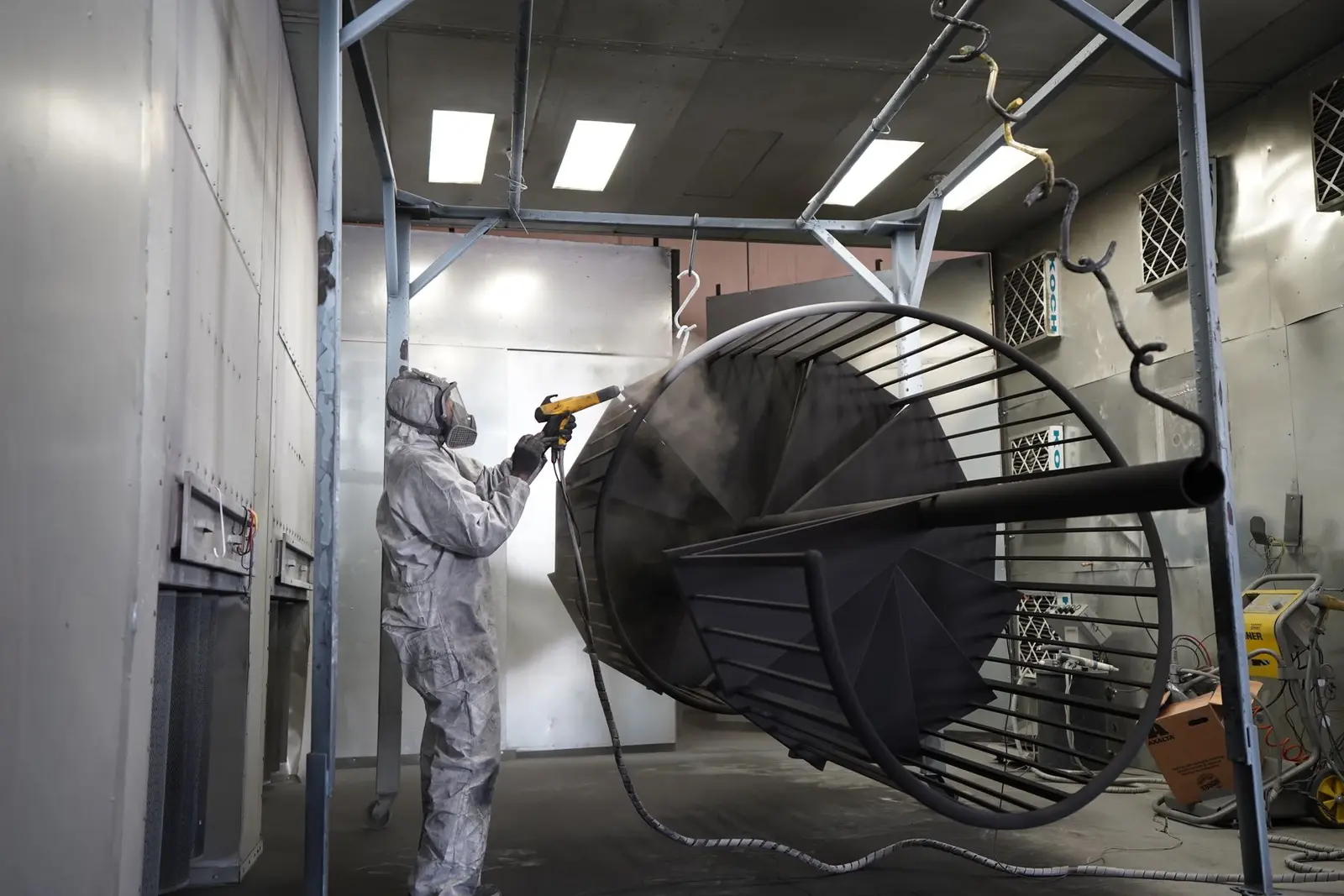
Metal components and fabrications
Apply primers, paints and protective coatings with a controlled robotic path.
Metal parts can range from small repeat components to frames and welded fabrications with deep recesses, edges and variable presentation. We engineer robotic coating concepts around preparation, coating chemistry, access, fixtures, film-build criteria and production flow.
Quick answer
Can a robot paint complex metal components?
Yes, where the robot, part handling and applicator provide access to the required surfaces. Six-axis motion and coordinated positioners can maintain a controlled gun angle and distance around frames, brackets, enclosures and fabricated assemblies.
The path is only one part of coating quality. Surface preparation, cleanliness, substrate temperature, coating condition, booth environment, flash and cure must be defined and controlled for the acceptance method.
- Critical faces, edges, recesses and exclusion zones marked on drawings
- Part mass, centre of gravity and fixture datum
- Coating data, target film build and recoat window
- Preparation, inspection and cure process documented
Coverage and access
Use fixtures and positioners to make difficult faces reachable.
Complex fabrications may shadow surfaces or require the gun to approach from several directions. A positioner can rotate the workpiece while the robot sprays, reducing extreme wrist positions and helping drainage or edge access where the process permits.
Reach simulation includes the complete applicator, hose package and fixtures. Trials then confirm that the proposed sequence achieves the agreed coverage without unacceptable runs, dry spray or excessive build at overlaps.
| Approach | Typical reason to consider it | Important checks |
|---|---|---|
| Small components | Multi-part fixtures or indexed nests | Loading accuracy and masking |
| Frames / weldments | Six-axis paths and positioners | Recesses, edges and hose access |
| Enclosures | Controlled faces and openings | Internal coverage and exclusion zones |
| Large fabrications | Long-reach or rail-mounted robot | Floor space, access and part handling |
Process choice
Select liquid, powder or electrostatic application from the duty.
Liquid and powder coatings have different booth, recovery, cure, cleaning and hazardous-area requirements. Electrostatic application can be considered where the material, conductive workpiece and earthing arrangement are compatible, while recesses and Faraday-cage effects need attention.
The best route is established from the specification and process trials. Generic transfer-efficiency or consumption claims should not replace measurement on the actual part family.
- Coating supplier requirements and safety data
- Conductivity, earthing and fixture contact points
- Colour frequency, recovery and cleaning strategy
- Oven, flash-off and production-line interfaces
Buyer questions
Answers for an initial application review.
Final equipment and performance are confirmed against your parts, material, environment and production requirements.
Browse all FAQs →Can one cell coat both small and large metal parts?
Possibly, if reach, fixtures, process settings, loading and cycle time cover the defined range. Large variation may be better divided into product families or stations.
Can the robot coat inside a fabrication?
Only where the applicator and robot can reach with an acceptable angle, distance and hose path. Access should be checked by simulation and representative trials.
Does robotic spraying guarantee film thickness?
No. Repeatable motion supports control, but material delivery, atomisation, part preparation, overlap and environment also affect film build. Acceptance testing is required.
Can you integrate pretreatment and curing equipment?
The cell controls can interface with upstream preparation, flash-off, oven and inspection equipment. The exact supply boundary is agreed in the project specification.
Discuss the real application
Turn your production need into a workable concept.
Share representative parts, material data, finish criteria and required output for an initial engineering review.