
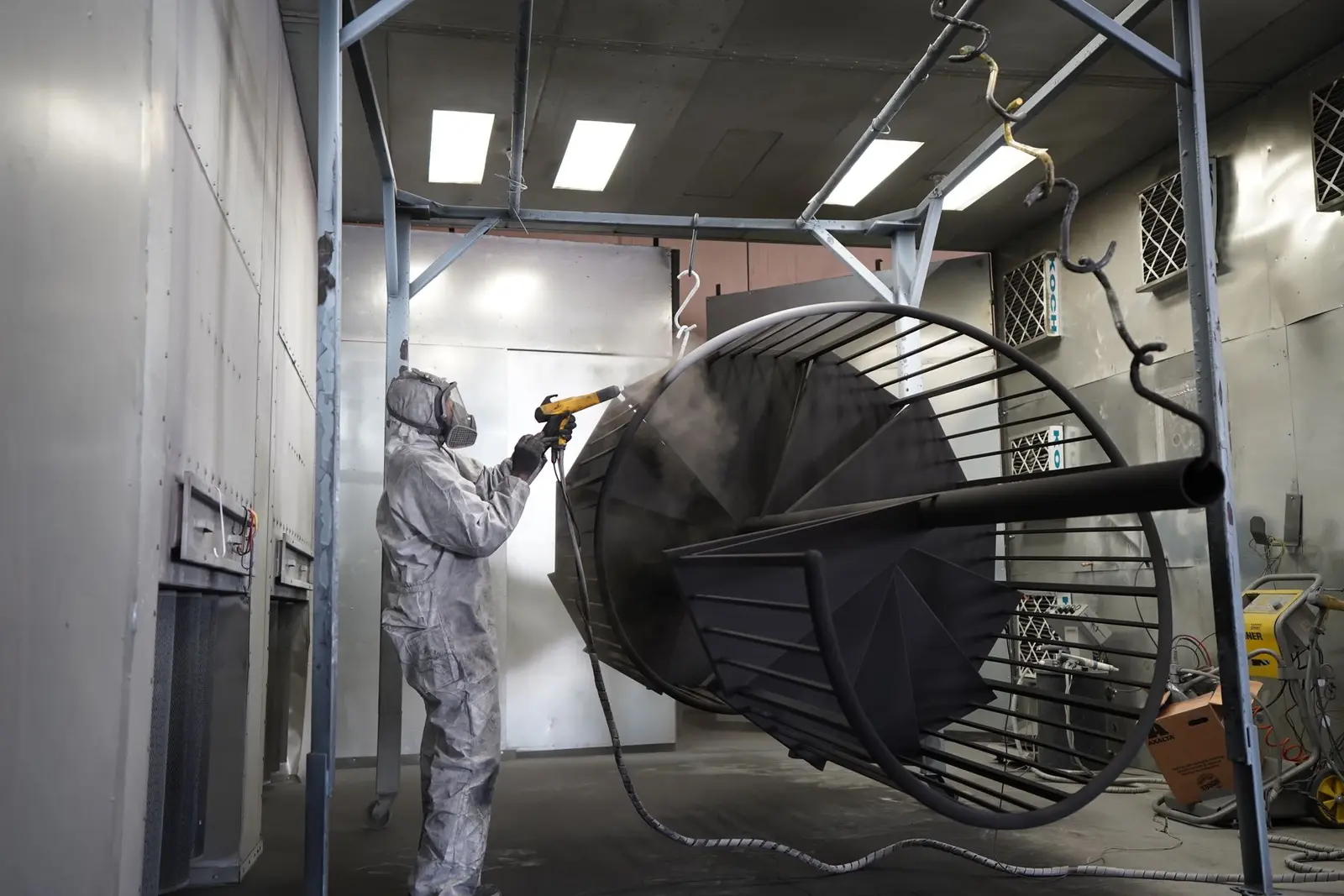
Powder coating robots
Automated powder coating shaped around coverage, recovery and cure.
A powder coating robot can repeat gun position, orientation, speed and trigger points across a defined part family. Oxford Industrial Automation integrates the robot with the powder application equipment, booth, extraction, part handling and line controls.
Quick answer
What does a powder coating robot control?
The robot moves one or more powder guns around the part using stored programmes. The programme coordinates the path and triggering while the powder equipment controls application parameters. Repeatability is strongest when part presentation, earthing, powder condition and booth environment are also stable.
Complex parts may need positioners, conveyor tracking or multiple applicators to reach internal and rearward surfaces without compromising cycle time.
- Six-axis or application-specific robot motion
- Single or multiple powder-gun arrangements
- Recipe selection for product families
- Conveyor, positioner and booth coordination
Coverage engineering
Plan for edges, recesses and changing part families.
Flat panels, frames, fabrications and complex assemblies present different access and electrostatic behaviour. A reach study checks physical access; trials help establish how the powder deposits on critical features.
Programming includes gun distance, angle, speed, overlap, voltage and output interfaces. The objective is a documented process window, not simply a path that looks correct with an empty gun.
- Critical finish zones defined on drawings or samples
- Part fixture and earth continuity considered
- Faraday-cage areas identified early
- Representative-part trials where uncertainty remains
Complete line
Integrate spraying with the wider powder process.
Pretreatment, drying, powder application, recovery and cure all influence the finished product. Our integration scope can coordinate the robot cell with conveyor status, booth permissives and upstream or downstream equipment.
Changeovers need a clear strategy for cleaning, retained powder, hose and gun access, recipe control and the acceptable risk of cross-contamination.
- Booth and extraction interfaces
- Conveyor tracking and part identification options
- Safe access and cleaning positions
- Line-level alarms, recipes and production states
Buyer questions
Answers for an initial application review.
Final equipment and performance are confirmed against your parts, material, environment and production requirements.
Browse all FAQs →Can robots powder coat complex fabrications?
Often, yes. Reach, recesses, earthing, shadowing, Faraday-cage effects and cycle time must be checked against representative parts.
Can a powder robot track a moving conveyor?
Conveyor tracking can be integrated where the conveyor signal, speed stability, part detection and required robot workspace support it.
Does robotic powder coating reduce powder use?
Repeatable paths and triggering can support material-control objectives, but the result depends on the complete electrostatic, booth, recovery and part process.
Can one cell handle several colours?
It may, but colour-change frequency, cleaning method, recovery arrangement, contamination tolerance and downtime should drive the concept.
Discuss the real application
Turn your production need into a workable concept.
Share representative parts, material data, finish criteria and required output for an initial engineering review.