
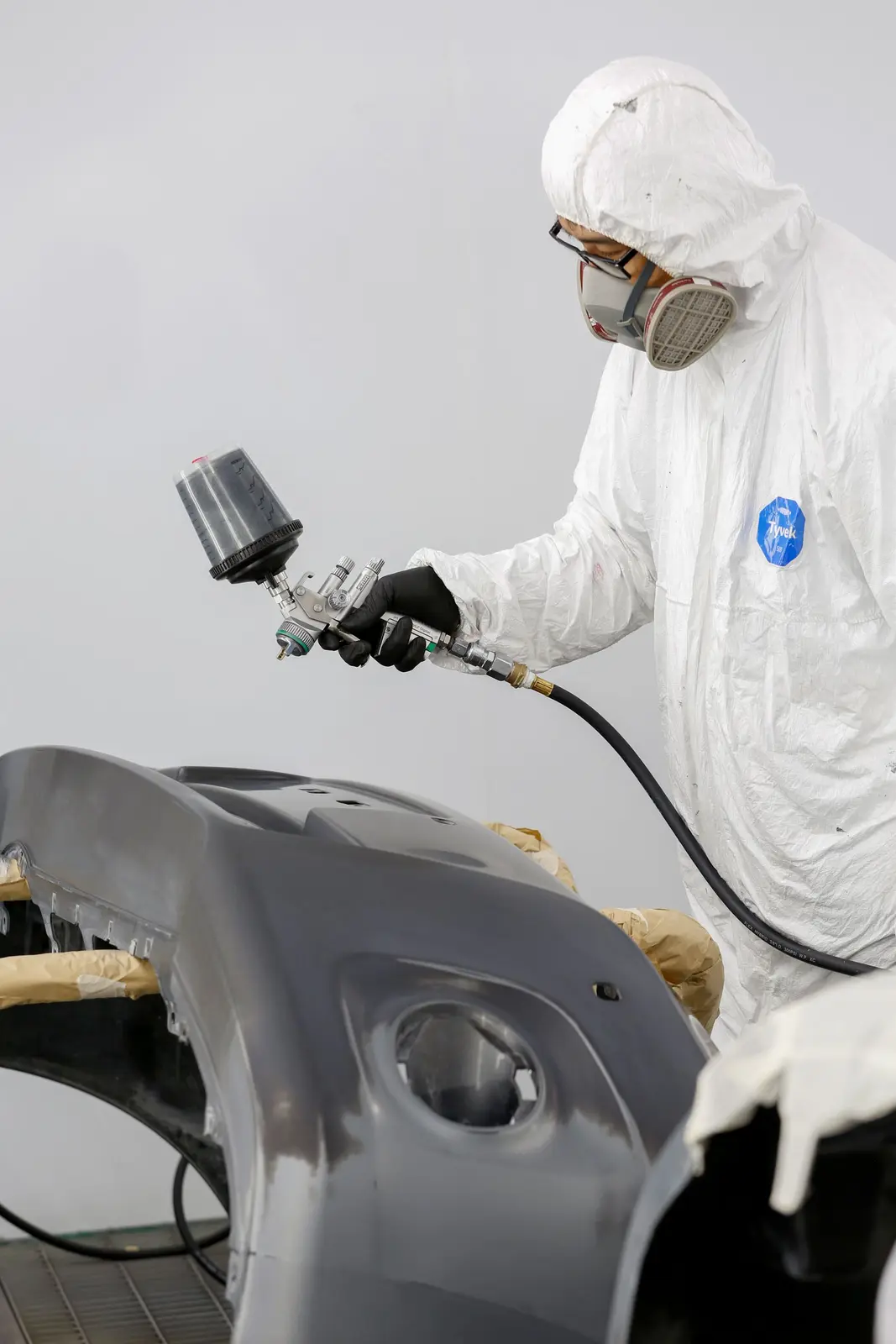
Robotic paint booths
A robotic paint booth engineered as one controlled production system.
A robotic paint booth combines repeatable robot motion with the enclosure, extraction, process equipment, interlocks and part handling needed for the coating. Oxford Industrial Automation integrates these elements around your parts, finish standard and production plan.
Quick answer
What is a robotic paint booth?
A robotic paint booth is an enclosed or controlled spray-finishing area in which an industrial robot carries the applicator along a programmed path. It is not simply a robot placed inside an existing booth: airflow, hazardous-area requirements, gun services, access, cleaning and recovery arrangements must work as a coordinated system.
The right concept begins with the material safety data, part envelope, finish zones and required output. These inputs determine whether a new booth, an adapted booth or a complete robotic spray cell is the sensible route.
- Robot and applicator selected for the real duty
- Extraction and booth interfaces included in the controls philosophy
- Fixtures, positioners or conveyors considered with the spray path
- Safe access, isolation and maintenance designed into the cell
Finish consistency
Control the variables that sit around the robot.
The robot can reproduce angle, stand-off distance, traverse speed and overlap. Consistent finishing also depends on stable part location, material preparation, atomisation, airflow and applicator condition. We define the process window and the checks needed to keep those variables under control.
Acceptance criteria can combine representative parts, defined coverage zones, film-thickness checks, visual standards, recipe verification and cycle-time evidence. The agreed test method is established before build.
- Repeatable part datums and presentation
- Recipe-controlled robot and spray parameters
- Booth permissives and extraction monitoring
- Documented cleaning and preventive-maintenance routines
Retrofit or new cell
Decide from evidence, not from the available floor space alone.
An existing booth may be suitable for automation if its dimensions, airflow, structure, services and classification support the proposed robot and material. A survey and application review are required before any retrofit assumption is made.
For a new installation, the layout can be shaped around loading, process access, finish inspection and future product variants. This often creates a cleaner route for cable management, extraction interfaces and changeover planning.
- Existing-booth survey and interface review
- Reach study using representative part geometry
- Loading, unloading and operator-access assessment
- Expansion and future-product considerations
Buyer questions
Answers for an initial application review.
Final equipment and performance are confirmed against your parts, material, environment and production requirements.
Browse all FAQs →Can a robot be added to an existing spray booth?
Potentially. The booth must be reviewed for space, airflow, structure, hazardous-area requirements, services, access and the intended coating process before a retrofit can be confirmed.
What information is needed to size a robotic paint booth?
Provide the largest and smallest parts, fixture concept, coating and safety data, required finish, production rate, current spray parameters and available floor space.
Does a robotic booth reduce overspray?
Repeatable gun paths and controlled triggering can support lower overspray, but the result depends on part geometry, transfer efficiency, atomisation, airflow and the tuned process.
Who is responsible for DSEAR and hazardous-area decisions?
The employer retains legal duties. Competent assessment and classification are required, with responsibilities and interfaces agreed across the customer, booth, extraction, process and integration teams.
Discuss the real application
Turn your production need into a workable concept.
Share representative parts, material data, finish criteria and required output for an initial engineering review.