
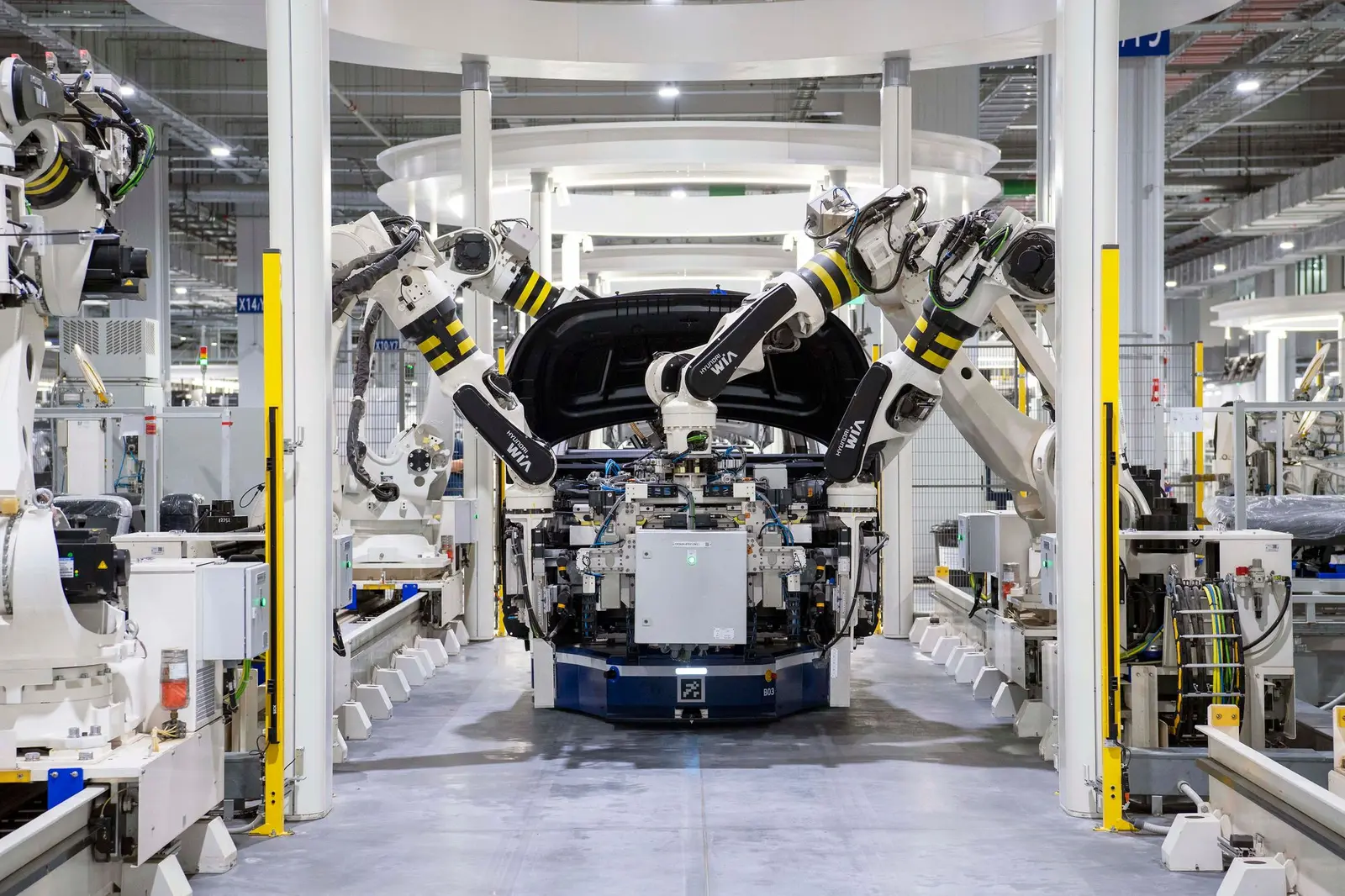
Conveyorised robotic spray lines
Coordinate the spray process with the way parts move through production.
A conveyorised spray line must keep part identity, position, robot motion, applicator control and booth permissives synchronised. We engineer indexed and continuous-flow concepts around the product mix, coating window, takt time and upstream and downstream process.
Quick answer
How does a robot spray parts on a conveyor?
In an indexed line, the conveyor stops and locates the workpiece while the robot runs a proved path. In continuous tracking, the robot synchronises its motion with a measured conveyor position while maintaining the required gun angle, distance, overlap and trigger points.
The line control maintains product identity and calls the correct process recipe. Sensors and permissives confirm that the part, extraction, material system and robot are ready before spraying begins.
- Reliable carrier or hanger identification
- Encoder and tracking datum selected for the line
- Recipe association maintained through the spray zone
- Defined handling for missing, doubled or misloaded parts
Indexed or continuous
Choose movement from finish, takt and product variation.
Indexed processing provides a stationary datum and can simplify complex paths or coordinated positioners. Continuous conveying can support steady production but uses robot travel to follow the moving part and places tighter demands on tracking and available work envelope.
Power-and-free and accumulation systems can decouple stages, but controls and carrier management become more important. Simulation and cycle analysis establish how many robots or stations are required.
| Approach | Typical reason to consider it | Important checks |
|---|---|---|
| Indexed conveyor | Complex parts or controlled dwell | Stop accuracy and accumulation |
| Continuous tracking | Stable flow and repeatable carriers | Encoder accuracy and tracking workspace |
| Positioner station | Multiple faces or difficult access | Load balance and coordinated motion |
| Parallel stations | Higher output or process separation | Line balance and recipe routing |
Complete paint line
Connect preparation, application, flash-off and cure.
Finish quality can be affected before and after the robot. Cleaning, pretreatment, masking, temperature, flash-off, curing and inspection need suitable buffers and fault responses. A stoppage in one zone should not create an uncontrolled condition in another.
The control philosophy defines line start-up, emptying, recipe changes, rework routing and recovery after faults. These operating states are proved alongside normal production.
- Upstream surface-preparation and loading interfaces
- Booth, extraction and material-system permissives
- Flash-off, oven and cooling-zone coordination
- Inspection, reject and rework route definition
Buyer questions
Answers for an initial application review.
Final equipment and performance are confirmed against your parts, material, environment and production requirements.
Browse all FAQs →Can a robot spray while the conveyor keeps moving?
Yes, where the line, encoder, part presentation and robot work envelope support continuous tracking. The complete path and finish must be proved at production speed.
Is indexed spraying more accurate?
It can simplify positional control because the part is stationary, but actual finish depends on location accuracy, fixtures, robot path, material delivery and process conditions.
How does the system select the right colour or recipe?
Part identity can be associated with a carrier, barcode, RFID, upstream PLC record or production command, with checks before the spray cycle is enabled.
Can the robotic station be added to an existing paint line?
Potentially, after reviewing line speed, carriers, available space, booth and extraction, controls, product tracking, outage requirements and the condition of retained equipment.
Discuss the real application
Turn your production need into a workable concept.
Share representative parts, material data, finish criteria and required output for an initial engineering review.