
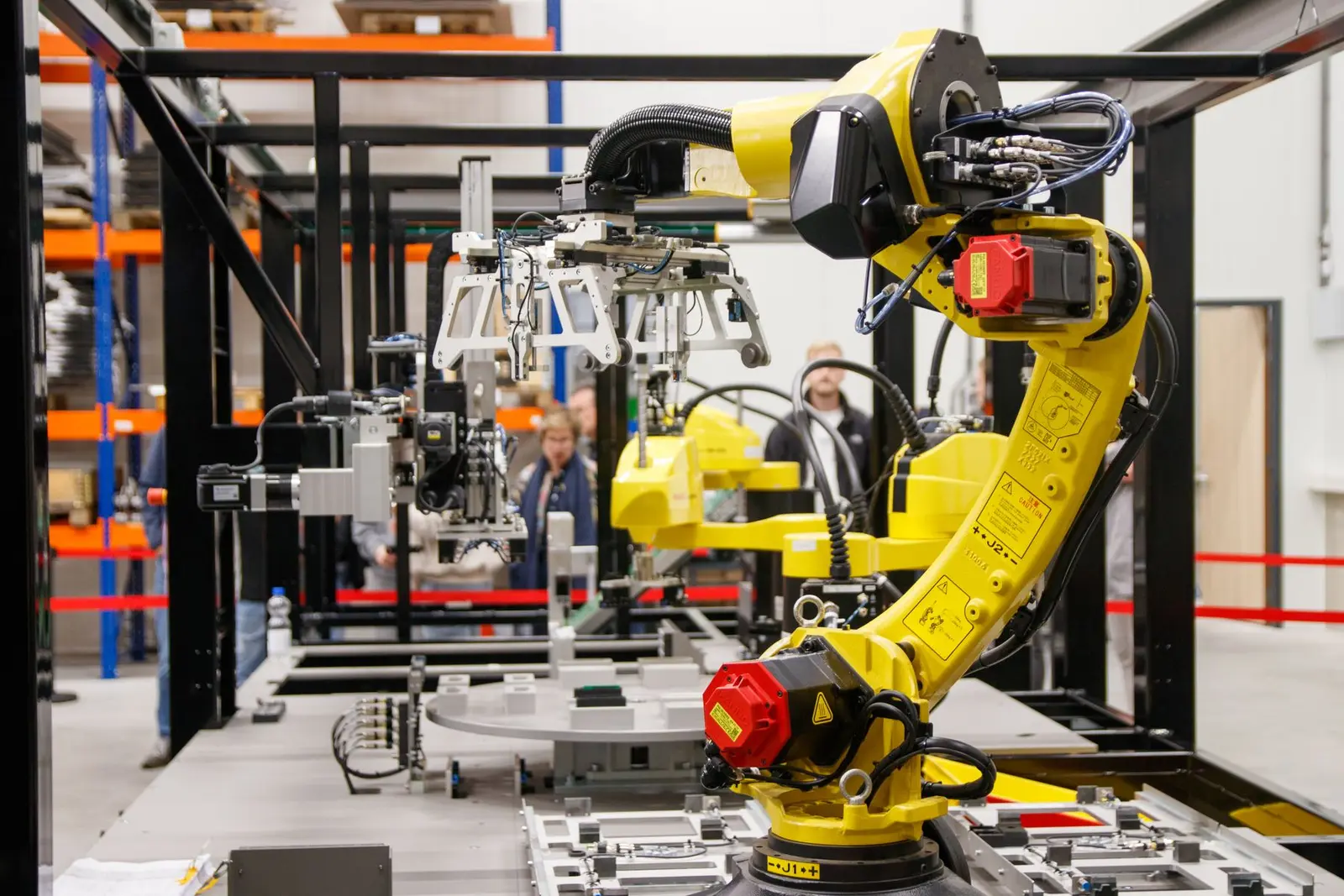
Vision-guided robotic spraying
Use vision where product variation cannot be solved reliably by fixtures alone.
A vision system can identify a part, measure its position or register a programmed spray path to the observed workpiece. The right architecture depends on variation, required accuracy, surface behaviour, line speed and how the result will be validated.
Quick answer
What is vision-guided robotic spraying?
Vision-guided spraying uses camera or 3D sensor data to support a robotic application. It may select the correct recipe, locate a known part, measure position and orientation, or calculate an offset that registers a previously proved path to the actual workpiece.
It is not automatically a self-programming paint robot. The scope must define what the vision system decides, what remains pre-programmed and what happens when confidence or geometry falls outside the accepted range.
- Product and variant identification
- Part-location or fixture-offset correction
- Path registration for controlled positional variation
- Detection confidence and reject or stop strategy
When vision earns its place
Compare sensing with better presentation and fixturing.
A precise fixture is often the simplest way to make a spray path repeatable. Vision becomes valuable when parts arrive with unavoidable positional variation, product mix is high, fixtures would be impractical or the process needs automatic identification.
The comparison should include sensor field of view, occlusion, reflectivity, coating contamination, cycle time and cleaning access. The camera itself is only one part of a dependable application.
| Approach | Typical reason to consider it | Important checks |
|---|---|---|
| Fixed datum | Repeatable parts and stable fixtures | Simple, fast and easy to validate |
| 2D vision | Identification or planar position changes | Lighting, contrast and visible features |
| 3D vision | Height, orientation or shape variation | Occlusion, surface response and scan time |
| Recipe + vision | Mixed products with controlled families | Identity logic and verified path limits |
AI and adaptive control
Define a bounded decision, then prove it on representative variation.
Machine learning may support recognition, segmentation or defect classification, but safety and finish acceptance still need explicit rules. A robust design records the sensor result, selected recipe, permitted offsets and the response to low-confidence data.
Trials should include good parts, expected variation and deliberately difficult cases. Acceptance covers detection performance as well as the deposited finish and overall cycle time.
- Documented training or reference data where applicable
- Bounded offsets and prohibited robot workspaces
- Low-confidence and no-detection handling
- Change-control method for new product variants
Buyer questions
Answers for an initial application review.
Final equipment and performance are confirmed against your parts, material, environment and production requirements.
Browse all FAQs →Can vision create a spray path automatically?
Some systems can generate or adapt paths for defined applications, but capability depends on part geometry, sensor data, software and the required process accuracy. It must be proved on representative parts.
Do we still need fixtures?
Often yes. Vision can compensate for selected variation, while fixtures provide stability, orientation, earthing and controlled movement during spraying.
Will paint mist affect the camera?
It can. Location, protective windows, purge air, cleaning access and inspection routines should be considered in the cell design.
Is vision-guided spraying the same as AI painting?
Not necessarily. Many dependable systems use conventional image processing and calibrated geometry. AI may support selected recognition tasks, but the useful question is what decision the system must make reliably.
Discuss the real application
Turn your production need into a workable concept.
Share representative parts, material data, finish criteria and required output for an initial engineering review.